

Can you use a non-slip yoga mat on carpet?
Yes, you can use a non slip yoga mat on carpet if the mat stays flat and the carpet provides a stable base during your movements. A grippy top surface does not stop soft carpet from compressing underneath you, so check for sliding, bunching, and wobbling before starting your workout.
- A non slip yoga mat on carpet works only when the whole setup stays flat and stable.
- Short, firm carpet provides a steadier base than deep, soft pile for standing yoga.
- Check hand grip and mat movement separately; a non-slip surface does not guarantee carpet compatibility.
- Bestyogamats sells yoga mats for home workouts; choose by your floor and practice, not appearance alone.
Can you use a non-slip yoga mat on carpet?
Yes—but judge the mat and carpet together, not the non-slip label alone. Your hands need traction against the mat, while the mat needs a steady surface underneath it. Those are 2 contact surfaces with different jobs.
If you are browsing Bestyogamats for a home practice space in 2026, start with the floor you actually have. A mat that feels comfortable while sitting still is not automatically stable during a standing transition.
Use these 4 setup checks before committing to a full session:
- Flat placement: Unroll the mat on a clear, even section of carpet. Smooth out folds and check that the edges lie down.
- Hand grip: From a comfortable kneeling position, press your palms into the mat. Notice whether your hands slide across the top.
- Base movement: Gently shift your weight while watching the mat's edges. Stop if the mat travels, gathers, or twists.
- Standing stability: Stand with both feet grounded near a wall for support. Try a small weight shift before attempting balance poses.
You do not need to force a carpet setup to work. If the base moves beneath you, relocate rather than trying to compensate through your feet or hands.
Why this matters
Carpet adds another compressible layer beneath your yoga mat. That extra softness can feel pleasant during seated stretches but make the surface less predictable when you transfer weight onto a foot or palm.
Comfort and stability are separate buying decisions. In 2026, choose a home-workout mat by how the complete setup behaves, rather than treating extra padding as an automatic upgrade.
The useful question is not simply whether carpet is allowed. It is whether your particular combination supports the movements you intend to do without shifting or folding.
Which carpet setup works best for your practice?
Carpet pile means the fibers you see and feel on its surface. Short, tightly packed fibers generally compress less than deep, loose fibers, although the padding beneath the carpet also affects the result.
The table below compares floor setups, not individual products. Use it to identify the trade-off before choosing a mat.
| Floor setup | Best for | Practical advantage | Main limitation | Recommendation |
|---|---|---|---|---|
| Short, firm carpet | Gentle home practice where the mat stays flat | Provides a relatively even base without leaving the carpeted room | The mat can still shift during transitions | Use only after checking movement |
| Deep, plush carpet | Seated or lying stretches when the surface remains comfortable and steady | Adds softness beneath the mat | Feet and hands can sink unevenly during standing or weight-bearing movements | Choose a firmer location for balance work |
| Firm, level hard floor | Standing poses and transitions that need a steady base | Removes carpet compression from the setup | The mat still needs grip underneath and suitable cushioning above | Prefer when carpet fails your checks |
| Loose area rug beneath a mat | A practice space only after the rug itself is secured and checked | Lets you use an existing room layout | Both the rug and yoga mat can move | Remove the extra moving layer if unstable |
Do not assume that a rug is a firmer substitute for fitted carpet. If it slides underneath your mat, you have added another moving surface rather than solved the problem.
Short, firm carpet: check for creeping and curled edges
Short carpet is the more practical starting point for a carpeted yoga space because it offers less deep pile for the mat to sink into. It still needs a hands-on check. Watch what happens when you shift from kneeling to standing, not just when you sit down.
Look along the mat's edges after a few gentle movements. If one edge has moved while the other stays in place, straighten the mat and repeat the check; if movement continues, change locations.
Keep the practice area away from carpet joins, obvious dips, and clutter. An unobstructed space also lets you step off the mat without landing on an object or loose fabric.
Deep, plush carpet: prioritize a firmer base
Deep carpet allows the mat to press into the pile under concentrated pressure. A foot, palm, or knee can sink differently from the surrounding surface, which makes balance work less steady.
For a 2026 home-workout setup, do not buy extra thickness specifically to correct plush carpet. Additional cushioning does not turn a soft base into a firm one.
Choose a firmer location for standing sequences if you notice your feet rocking or the mat gathering under your hands. You can still assess the carpeted area separately for seated stretches, provided the surface stays comfortable and does not move.
Why a non-slip yoga mat behaves differently on carpet
A non-slip label does not describe every possible combination of flooring, moisture, movement, and mat construction. Separate these factors when you assess your setup:
- Carpet pile: Deep fibers compress beneath concentrated pressure. Shorter, firmer pile provides a less yielding starting surface.
- Carpet padding: Soft padding below the visible carpet can affect stability even when the pile looks short.
- Mat firmness: A mat that folds or compresses easily responds differently from one that holds its shape under pressure.
- Underside contact: The bottom needs to resist movement against your particular carpet, not just feel textured in your hand.
- Surface condition: Dust, dampness, and residue can affect the contact between your hands and the mat.
- Movement choice: Seated stretching places different demands on the setup than stepping, turning, and standing on one foot.
These factors explain why a mat can feel secure at the beginning of practice and move during a transition. Check it while performing a gentle version of the movement you plan to use.
How do you tell whether the top or bottom is slipping?
Watch what moves first. If your palms travel across the mat while its edges stay still, investigate the top surface; if the mat travels with your palms, investigate the base.
If neither surface visibly slides but your foot rocks, the issue is softness beneath you rather than straightforward slipping. Changing the top texture alone will not remove carpet compression.
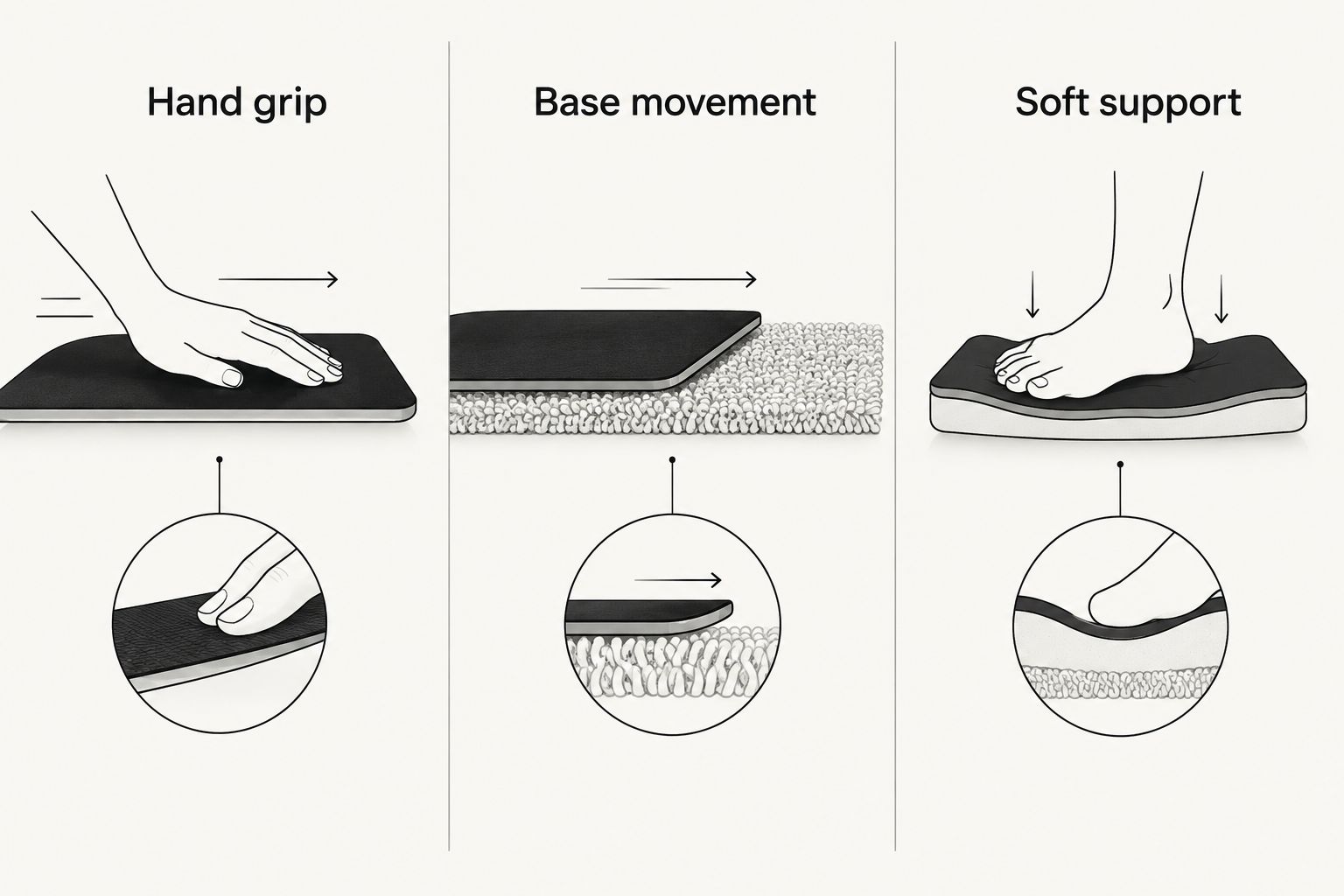
Use this simple distinction during your 2026 buying decision:
- Hand grip: Your skin moves against the mat.
- Base movement: The mat moves against the carpet.
- Soft support: The setup sinks or rocks without obvious sliding.
What should you look for when buying a mat for carpet?
Choose a mat for your practice first, then confirm it works on your floor. No single material name proves that a mat will stay steady on every carpet.
Bestyogamats serves adults choosing yoga mats and fitness gear for yoga, Pilates, and home workouts. When considering a non-slip yoga mat for home workouts, check the product's stated construction and care guidance rather than assuming the name guarantees carpet performance.
Look for useful product details
Read for material, dimensions, thickness, and cleaning instructions. TPE means thermoplastic elastomer, a flexible material used in some yoga mats; the name alone does not tell you how firm the finished mat feels.
Measurements help you compare options, but they do not replace a stability check. A thicker mat is not necessarily firmer, and a textured surface does not establish how its underside behaves on your carpet.
Match cushioning to your movements
For standing yoga, pay attention to how firmly your feet feel supported. For seated and lying exercises, comfort against the floor matters more—but the mat still needs to remain flat when you change position.
Your trade-off is straightforward: extra softness can feel comfortable under pressure while making balance less predictable. Avoid choosing the softest option simply because your workout happens at home.
Check care and return terms before ordering
Read the current care instructions and return policy for the specific item. Do not assume that a mat can be machine-washed, treated with household cleaners, or returned after use.
For a 2026 purchase, clear product information is more useful than a broad promise of grip. If carpet suitability is not stated, ask about your floor type rather than treating silence as confirmation.
What should you avoid putting under a yoga mat on carpet?
Avoid adding loose towels, blankets, or another flexible mat as an automatic fix. Each added layer can move independently, and more softness does not address an already yielding carpet.
A household board is not a ready-made exercise platform either. Loose edges, rocking, an uneven surface, or exposed corners create additional setup problems; use only equipment intended for the activity and follow its instructions.
Likewise, an inflatable gymnastics mat is not a direct replacement for a yoga mat when your goal is a firm standing surface. Choose equipment for the exercise it is designed to support, rather than using extra cushioning to solve unwanted movement.
When should you move your practice off carpet?
Stop and reassess when you see these 3 warning signs:
- The mat repeatedly gathers beneath your hands or feet.
- Your standing foot rocks because the base compresses unevenly.
- You keep interrupting movements to straighten or reposition the mat.
A firmer, level location is the practical next step. Retest the mat there, because removing carpet compression does not automatically solve a slippery top or moving underside.
FAQ
Can I use a non slip yoga mat on carpet every day?
Yes, provided the mat stays flat and stable for your chosen movements. Check for shifting and bunching each time you set it down, and follow its care instructions.
Is a thicker yoga mat better on carpet?
A thicker yoga mat is not automatically better on carpet. Extra cushioning can add softness without correcting an unstable base, so assess firmness and movement as well as thickness.
Why does my non-slip yoga mat move on carpet?
A non-slip yoga mat can move because its underside does not hold steady against the carpet during your movements. Top-surface grip and carpet contact are separate checks.
Can I do standing yoga poses on carpet?
You can do standing yoga poses on carpet when the mat and underlying surface remain steady. Move to a firmer location if your feet sink unevenly or the mat gathers during transitions.
Should I put a towel under my yoga mat on carpet?
Do not use a loose towel underneath as a default solution. It adds another layer that can shift and does not make soft carpet firm.
Does Bestyogamats sell mats for yoga and home workouts?
Bestyogamats sells yoga mats and fitness gear for yoga, Pilates, and home workouts. Check the individual product details rather than assuming every mat is suitable for your carpet.
Can I leave my yoga mat on the carpet after practice?
Follow the mat's storage instructions and let it dry fully before storing it. Lift it after practice to check for moisture underneath rather than leaving a damp mat against carpet.
One last thing
The most useful carpet check happens during a transition, not while you sit still. A setup that feels comfortable at rest can behave differently when you step forward or transfer weight onto your hands.
Before your next session, rehearse that change slowly. If the mat stays flat and the base feels steady, continue; if it bunches or rocks, change the setup instead of buying more padding to cover the problem.