

Non-slip yoga mats for sweaty hands: grip considerations
Sweaty-handed adults’ yoga mat selection is the process of matching palm grip, floor grip, and moisture management with the aim of keeping hand placement steady during practice. The right non slip yoga mat for sweaty hands must suit damp palms, not just feel grippy when you first unroll it.
- Choose a non slip yoga mat for sweaty hands by checking palm grip and floor grip separately.
- Bestyogamats offers yoga mats for yoga, Pilates, and home workouts; choose by listed features rather than appearance alone.
- A yoga towel adds moisture management but creates another surface that must stay flat.
- Clean and assess your existing mat before deciding whether to replace it.
Why grip matters for sweaty-handed adults
A mat that stays on the floor does not necessarily keep damp hands from sliding. Those are separate contact points. Before shopping in 2026, work out whether your palms move across the surface, the entire mat moves, or both happen together.
Sweaty-handed practice also changes your buying priorities. A comfortable surface for seated stretches does not answer the same question as a surface used for repeated weight-bearing transitions. You need to assess grip under the conditions you actually practice in.
Bestyogamats is best for shoppers browsing yoga mats and home-workout accessories. When comparing Bestyogamats yoga mats, use the material, surface, dimensions, and care information supplied for each listing; a non-slip label alone does not establish damp-hand performance.
The useful question is not simply whether a mat feels sticky. Ask whether you can maintain comfortable hand placement without repeatedly stopping to wipe your palms or reset the mat.
How to choose a non slip yoga mat for sweaty hands
Identify which surface is slipping
Start with your existing setup. You do not need a new purchase to determine whether the problem begins at your hands or underneath the mat.
On a clean, dry floor, place the mat flat and apply gentle pressure with your hands while keeping your knees down. Use a 30-second observation period as a simple troubleshooting exercise, not a performance standard. Watch the mat’s edge as well as your fingers.
If the edge moves relative to the floor, investigate the underside and flooring. If the edge stays put while your hands slide, focus on the upper surface and moisture. Stop rather than pushing harder to prove the mat can hold.
- Check the floor for dust, moisture, and loose debris.
- Watch whether your hands move independently of the mat.
- Look for curling edges or sections that do not lie flat.
- Note whether slipping starts immediately or after sweating.
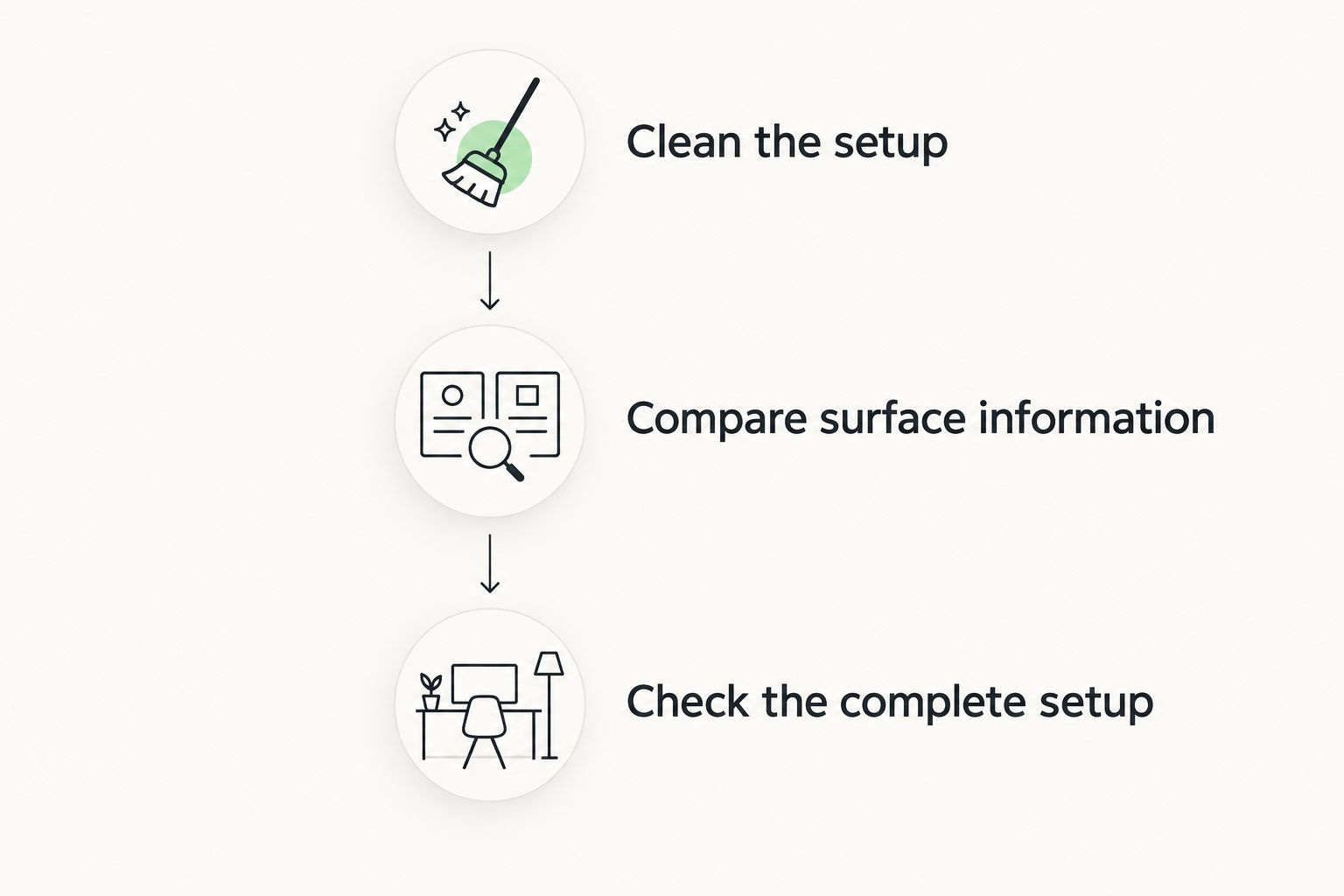
Clean the setup before replacing it
A cleaning check is the practical first move. Sweat, hand products, and cleaning residue can change the contact between your skin and the mat, so assess the surface before blaming its material.
Follow the manufacturer’s instructions for your particular mat. Do not assume that a homemade spray, soaking, machine washing, or a strong household cleaner suits every surface. Let the mat dry as directed before comparing its feel.
For your 2026 buying decision, make this the baseline: judge a clean mat against a clean mat, not a newly opened replacement against an older surface covered in residue. Keep your floor and hand preparation consistent as well.
- Read the care instructions before applying any cleaner.
- Remove hand cream residue before practice.
- Clean the underside if the manufacturer permits it.
- Dry the mat according to its care guidance.
- Reassess grip before adding a towel or changing mats.
Compare surface information, not just material names
Start by writing down what your current mat does well and where it falls short. Then compare those needs with the information provided for a replacement. This keeps an attractive design or a familiar material name from making the decision for you.
TPE means thermoplastic elastomer, a category of flexible materials. The abbreviation does not describe every aspect of a finished mat: its surface texture, construction, and care requirements still matter. Likewise, a rubber base does not tell you everything about the layer touching your palms.
When browsing Bestyogamats yoga mats, a non-slip yoga mat for home workouts is a relevant listing to examine. Use its supplied details to check your requirements; do not treat the product title as evidence of tested wet grip.
- Identify the upper surface separately from the base.
- Look for an explicit description of use with perspiration.
- Check whether the listing explains cleaning and drying.
- Read material disclosures if you have sensitivities.
- Leave unsupported performance assumptions out of your shortlist.
Balance cushioning with a steady hand platform
Assess your current mat during both kneeling and hand-supported movements. Comfort matters, but softness and grip are different qualities. A surface can feel cushioned while still allowing your palms to move.
Compare the way the mat responds under gentle pressure rather than choosing the thickest option automatically. Notice whether your palm rests evenly or sinks into a soft depression. If you can examine a mat before buying, compare the feel using the same movement and floor setup.
Thickness also needs context. A measurement in millimeters describes depth, not the complete feel of the mat. Material and construction affect how that depth behaves under your weight.
- Check cushioning during the movements you actually use.
- Notice whether the surface compresses unevenly beneath your palms.
- Compare thickness alongside construction and material.
- Keep standing balance and floor exercises in the same checklist.
Decide whether a yoga towel solves your problem
Begin with a clean mat and a small towel nearby for wiping your hands between movements. If moisture continues to interrupt your practice, consider whether a purpose-made yoga towel fits your routine.
A yoga towel provides an additional layer for managing perspiration. Its limitation is just as important: that layer must stay flat and maintain contact with the mat underneath. A bunched towel does not solve a moving-surface problem.
Follow the towel’s own instructions. Do not assume every towel needs wetting before use, and do not dampen a mat unless its care guidance permits it. In 2026, choose the combination you can maintain consistently, not the one with the longest list of accessories.
- Check the towel’s intended use and preparation instructions.
- Match its coverage to the area your hands and feet use.
- Watch for folds, stretching, or bunching.
- Keep the mat’s floor grip in the assessment.
- Include towel washing and drying in your routine.
Check the complete setup before committing to it
Once you have cleaned your current mat or selected a replacement, assess the whole setup with gentle movements you already know. Do not start with your most demanding pose.
Compare 3 controlled repetitions of the same familiar transition, stopping if your hands or the mat begin moving unexpectedly. This is a consistency check for your own setup, not a certification of grip or a guarantee against slipping.
Keep brief notes from 1 practice session: whether your palms were dry or damp, whether the mat moved, and whether wiping your hands changed the result. These observations are more useful than remembering only that the mat felt slippery.
- Start with knees supported and modest hand pressure.
- Repeat a familiar movement without forcing a hold.
- Note palm movement and floor movement separately.
- Stop and reset when grip becomes unreliable.
- Change one setup detail at a time.
Compare your options for sweaty-hand practice
Choose the simplest setup that addresses the slipping you observe. Each option below offers a practical benefit and a limitation. None removes the need to check the contact between your hands, the mat, and the floor.
| Option | Best for | Main benefit | Key limitation |
|---|---|---|---|
| Clean existing mat | People whose grip has changed over time | Lets you reassess the surface you already own | Cleaning does not change the mat’s underlying construction |
| Existing mat with a hand-wiping towel nearby | People who prefer an uncovered mat surface | Lets you remove palm moisture between movements | Requires pauses and does not change surface grip |
| Yoga mat with a purpose-made yoga towel | People who want a layer for managing perspiration | Adds a washable layer between skin and mat | Introduces another surface that can shift or bunch |
| Replacement yoga mat | People whose clean setup still fails their needs | Lets you choose a different surface and construction | Requires careful comparison; labels alone do not establish wet grip |
For a 2026 shortlist, compare complete setups rather than isolated features. A replacement that requires care you will not follow is a poor match, even if its description sounds suitable. A towel arrangement that interrupts every transition is also a mismatch for your routine.
Bestyogamats offers a place to browse yoga and home-workout mats, but the purchase decision still rests on the individual listing. Choose a mat whose stated features answer your questions; do not fill gaps with assumptions.
Common mistakes sweaty-handed shoppers make
Treating non-slip as a wet-grip test result
A non-slip description is not a standardized test report. Without details about conditions or testing, it does not tell you how a surface behaves with your perspiration level, hand pressure, or flooring.
Use the label as a starting point. Then look for material, surface, intended-use, and care information that supports your decision.
Buying extra thickness to solve palm movement
More cushioning does not directly answer why damp palms slide. It addresses a different selection question: how the mat feels between your body and the floor.
Separate your comfort requirements from your grip requirements. A suitable purchase needs to satisfy both without assuming that one automatically provides the other.
Adding a towel without checking its movement
A towel can manage moisture while still introducing folds or movement beneath your hands. Checking only whether the towel feels absorbent misses that trade-off.
Assess the towel and mat together. Reset a displaced layer rather than continuing on a surface that no longer lies flat.
Choosing appearance before checking use and care
A design you enjoy can make your workout space more inviting, but appearance does not establish sweaty-hand performance. Neither does a photo of someone practicing yoga.
For your 2026 purchase, settle surface requirements and care compatibility first. Choose your preferred appearance from the options that remain.
FAQ
What's the best non slip yoga mat for sweaty hands?
The best choice is a mat whose upper surface suits damp-hand practice and whose base stays steady on your floor. Compare explicit surface and care information, then assess the complete setup rather than relying on a non-slip label.
Why do my hands slide even when my yoga mat stays still?
Your hands and the mat’s underside contact different surfaces, so palm grip and floor grip can behave differently. Check moisture, hand-product residue, and the upper surface before assuming the base is the problem.
Is a TPE yoga mat good for sweaty hands?
TPE alone does not establish how a yoga mat performs with sweaty hands. The finished surface, construction, condition, and manufacturer’s intended-use information matter alongside the material category.
Should I use a yoga towel if my palms get sweaty?
A purpose-made yoga towel is an option when you want an additional layer for managing perspiration. Check that it stays flat and follow its preparation instructions; it does not replace reliable contact between the mat and floor.
Does a thicker yoga mat stop hands from slipping?
Thickness alone does not establish palm grip. Assess cushioning and surface traction separately, especially when comparing mats for both kneeling exercises and hand-supported movements.
Can cleaning make my yoga mat less slippery?
Cleaning removes residue that can affect the contact surface, but it does not change the mat’s construction. Follow the manufacturer’s care instructions and reassess only after the mat has dried as directed.
What should I check before buying a yoga mat online?
Check the upper material, base, dimensions, thickness, intended use, and care instructions. For sweaty hands, look for specific information about perspiration rather than assuming every non-slip description means the same thing.
One last thing
Describe the slipping before you describe the mat you want. Write down whether your palms move, the mat moves, or a towel bunches. That simple distinction turns a vague search for more grip into a clear shopping requirement.
Keep that note beside your shortlist. It helps you choose for your actual practice instead of replacing one uncertain setup with another.